Why a Ban on Diesel Exports Would Backfire
Estimated reading time: 7 minutes
The Allure of Lower Prices
Consumers have been focused on the cost of living for years now. Although inflation has cooled from its 2022 peak, affordability concerns remain top of mind for voters and will likely be a powerful influence on elections. This is especially true of highly visible expenses like gas, rent, and groceries.
Recently, the focus has shifted to diesel. Diesel now costs $6.52/gallon, 83% more than it did at the start of the year. Though most consumers don’t buy the fuel directly, it’s an important part of the supply chain — powering things like tractor-trailers, freight rail networks, and agricultural and industrial machinery.
This is why people are talking about restricting or banning U.S. diesel exports. (In fact, Politico just reported that the Trump administration is “preparing a plan” for a 90-day ban, citing anonymous sources.)
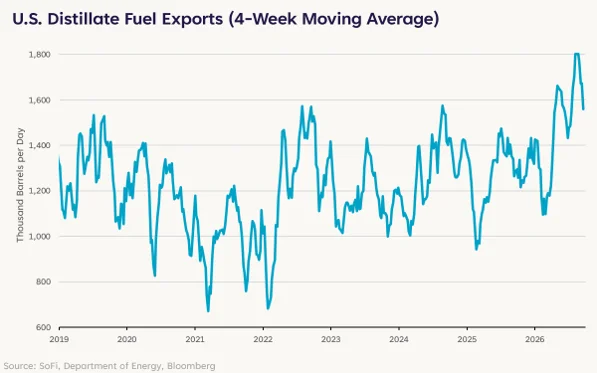
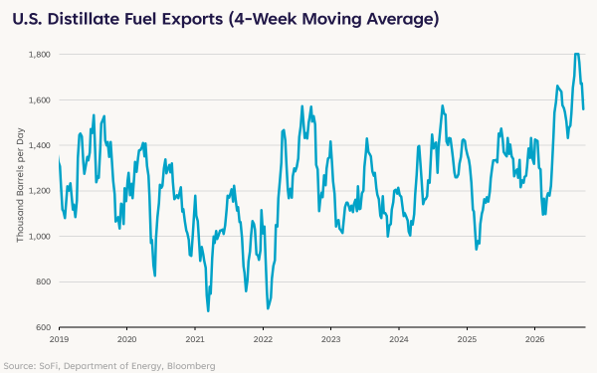
The idea of a ban rests on simple logic: The country currently exports over 1.5 million barrels of distillate fuel per day, of which almost all is diesel. Keeping more of that fuel at home would increase domestic supply, and in theory, ease pressure on prices.
But like most things, it’s not that simple. Global energy markets are highly interconnected by networks built over decades. You can’t isolate American energy products without creating layers of indirect effects.
Refinery and Regional Bottlenecks
To understand why a ban would backfire, let’s play out the scenario: If exports are banned, the U.S. keeps the diesel that it usually sends overseas, lowering wholesale diesel prices on the Gulf Coast where most of the country’s production occurs. But then domestic storage tanks would fill up and could hit max capacity pretty quickly. Once there was nowhere left to store diesel, refiners wouldn’t be able to process nearly as much crude oil.
This would lead to two unintended consequences.
First, refiners would have to slow production of all refined products, not just diesel. Processing crude oil generally yields a fixed proportion of products. Refiners can’t really say, “Hey, we don’t have any more storage for diesel, so let’s stop making that and just focus on gasoline or jet fuel.”
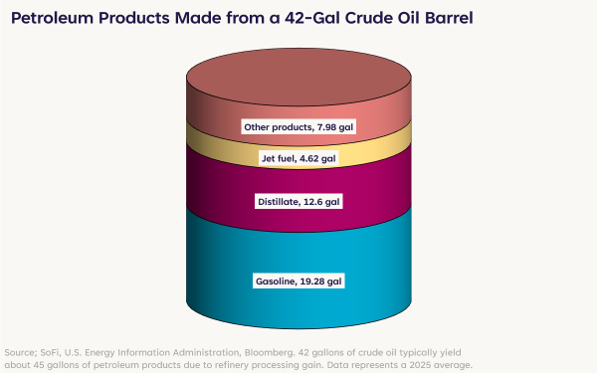
In other words, what starts off as an attempt to lower prices would wind up pushing gasoline and jet fuel prices higher. Plus, any initial relief in diesel prices would eventually be undone by the decline in overall production.
Second, international diesel prices would rise because an export ban would remove meaningful supply from the global market. This would also impact prices on the U.S. East Coast, which is reliant on imported fuel because it consumes more than it produces. (Gulf Coast refineries produce much more than the region consumes, but it’s hard to get that fuel to the East Coast because of limited pipelines and maritime laws like the Jones Act.)
As a result, the East Coast would see higher prices despite the glut in the South. Higher regional fuel prices would flow through to other goods and services, and there would be a lot of general price uncertainty.
Global Boomerang
The U.S. accounts for a meaningful portion of global diesel exports. And wars between Russia and Ukraine and the U.S. and Iran have already disrupted international refining. Cutting exports would just send more shockwaves overseas and could eventually boomerang back to the U.S. in the form of imported inflation. Remember: Diesel touches many parts of the global supply chain. As transportation and energy costs rise, businesses tend to pass some (or all) of their costs through to their customers in order to protect their margins.
The ripple effect could be similar to what we’ve seen with the crude oil bottleneck in the Strait of Hormuz. That’s pushed overall inflation higher, putting the Federal Reserve in a tough spot.
More specifically, here are some of the potential ramifications:
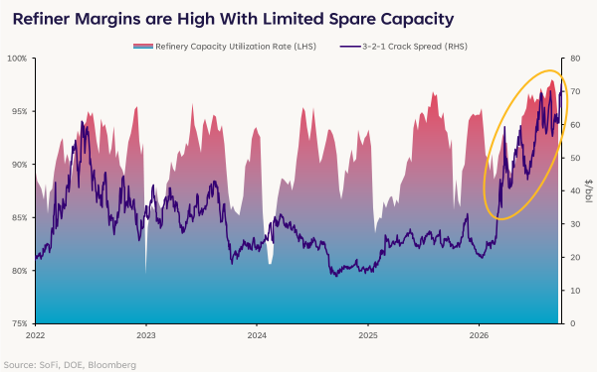
Pure-play U.S. refiners and operators are currently benefiting from historically high capacity utilization rates and crack spreads (the margin between the cost of raw crude oil and the price charged for refined fuels). But a domestic supply glut would hamper them. On the other hand, it’s possible that trucking companies and railroads could see a temporary margin tailwind from lower fuel costs.
International refiners would likely see the reverse effect. International crack spreads would rise if there was less U.S. supply to compete against. More broadly, energy-exporting markets would probably outperform, while energy importers would likely underperform.
So, although the EU’s STOXX 600 could lag the S&P 500, and the euro would probably depreciate against the U.S. dollar, countries like Norway and Brazil could see a boost in their currencies and stock markets. The emerging markets most reliant on energy imports would be most exposed.They’d probably be faced with the triple whammy of high energy prices, sharp currency depreciation, and inflation-related monetary policy tightening.
To Ban or Not to Ban
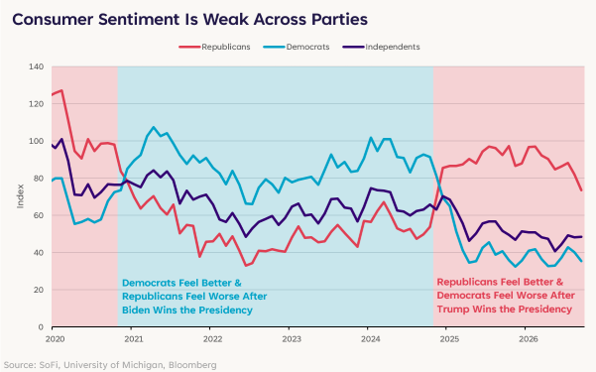
The general consensus is that an export ban would be counterproductive. It would raise barriers to the efficient flow of goods, lower production, and lead to higher prices over the longer-term. Nevertheless, political pressure to do something is high. Voters across political spectrums are souring on the economy, and midterm elections are a little over a month away.
The path of least resistance may be a temporary ban lasting only through the end of the year. The idea would be: Try to provide some immediate relief but stave off deep production cuts.
But is that good policy-making, or even a sustainable solution? Maybe not. As investors, our job isn’t to decide what’s optimal or what aligns with our own personal dispositions. It’s to dispassionately judge the likeliest course of events, and how the market may react. Can our emotional and cognitive biases affect those judgments? Of course. But we can still give it a go. The market is filled with competing viewpoints, and this is my honest view of it.
Disclaimer
SoFi Securities (Hong Kong) Limited and its affiliates (SoFi HK) may post or share information and materials from time to time. They should not be regarded as an offer, solicitation, invitation, advice, recommendation to buy, sell or otherwise deal with any investment instrument or product in any jurisdictions. Keep in mind that investing involves risk, and past performance of an asset never guarantees future results or returns. It’s important for investors to consider their specific financial needs, goals, and risk profile before making an investment decision.
SoFi HK does not make any warranties about the completeness, reliability and accuracy of this information and will not be liable for any losses and/or damages in connection with the use of this information.
The information and materials may contain hyperlinks to other websites, we are not responsible for the content of any linked sites. The information and analysis provided through hyperlinks to third party websites, while believed to be accurate, cannot be guaranteed by SoFi HK. These links are provided for informational purposes and should not be viewed as an endorsement. The risk involved in using such hyperlinks shall be borne by the visitor and subject to any Terms of Use applicable to such access and use.
Any product, logos, brands, and other trademarks or images featured are the property of their respective trademark holders. These trademark holders are not affiliated with SoFi HK or its Affiliates. These trademark holders do not sponsor or endorse SoFi HK or any of its articles.
Without prior written approval of SoFi HK, the information/materials shall not be amended, duplicated, photocopied, transmitted, circulated, distributed or published in any manner, or be used for commercial or public purposes.
Crypto and Crypto ETF products are available only to members in eligible jurisdictions who have successfully completed the required assessments and maintain an appropriate risk profile.
This communication is not directed at, and is not intended for distribution to or use by, any person in the United Kingdom. It does not constitute a financial promotion for the purposes of Section 21 of the Financial Services and Markets Act 2000. This material is not available to any UK Person. By accessing, viewing, or relying on this communication, you represent and warrant that you are not a UK Person and that you are not located in the United Kingdom.


About SoFi Hong Kong
SoFi – Invest. Simple.
SoFi Hong Kong is the All-in-One Super App with stock trading, robo advisor and social features. Trade over 15,000 US and Hong Kong stocks in our SoFi App now.