The Obsession With Inflation
Estimated reading time: 6 minutes
Stuck Like Glue
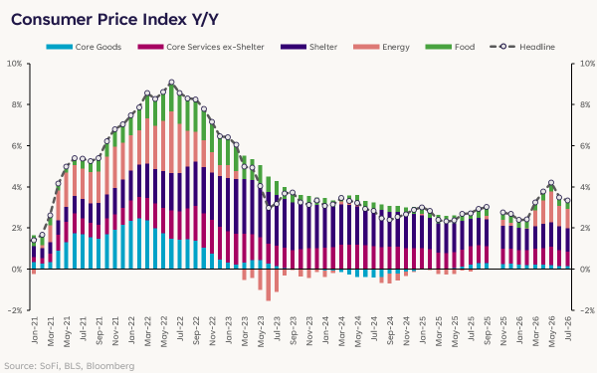
Not only is inflation stubbornly stuck like glue above the Federal Reserve’s 2% target, but the Fed’s benchmark rate is also stuck where it is for the time being, in our view. We do not see a rate hike coming in September, although we do expect at least three dissenting votes again, if not more.
Without forward guidance from the Fed, the July CPI report was highly anticipated as market participants searched for anything that could help set expectations for the central bank’s next move. However, the data was rather boring, coming in exactly in line with consensus expectations and slightly lower than the previous month.
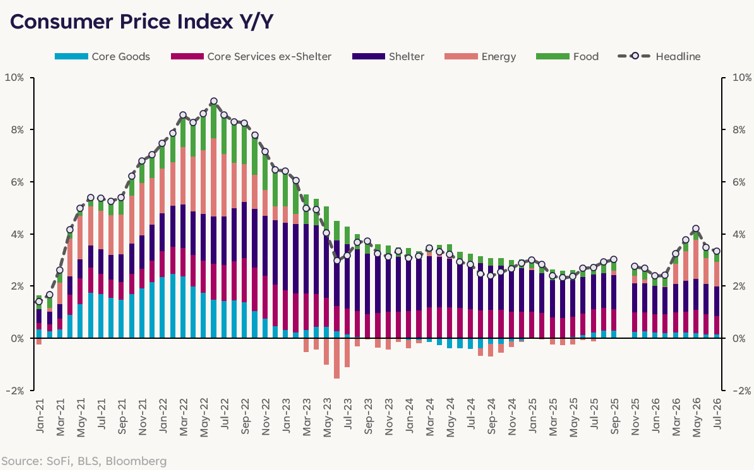
The Fed has kept its target rate in a range of 3.50%-3.75% since December 2025. It’s become almost a coin toss between holding steady and hiking rates, which is giving markets anxiety. Investors like certainty, and the path of rates is far from certain.
Regardless of whether or not you believe the Fed’s veil of mystery is good or bad (We happen to believe it’s good for now), it’s likely to stay this way for a while.
What Can Investors Do?
The news is obsessed with inflation. The Fed seems obsessed with inflation. Investors are, as a result, obsessed with inflation. That’s all understandable given stubborn inflation for the last five years, but it’s turned too many people into headline-driven traders instead of long-term investors.
Let’s try to shift the focus back to the longer term and look at what we can do with portfolios if we are in an era of what we are calling “warm inflation”.
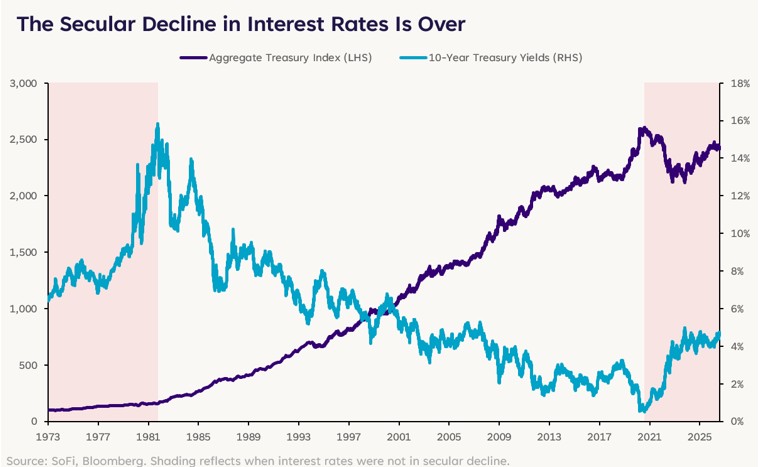
Warm inflation goes hand-in-hand with interest rates, which have a direct effect on bond yields. Higher rates result in higher yields, which means lower bond prices. After roughly 40 years (we are not exaggerating) of falling Treasury yields — thus rising Treasury prices — we have entered a new era where bond yields are higher and bond prices are lower, or at the very least bond prices are volatile. Therefore, they haven’t provided the same diversification benefit when paired with stocks.
It’s also worth mentioning the broader market environment we’re in, with heightened geopolitical risk, increased global unrest, and disrupted oil markets.
So what can investors use as a hedge against higher inflation and volatile oil markets, since both seem to be sticking around for a while?
The answers to these questions will vary depending on who you ask — and what their goals are — but to answer them in the broadest one-size-fits-most way, we’d suggest an allocation to commodities.
Proof of Concept
A deep dive into asset allocation and risk/return profiles is beyond the scope of this column, but we’ll briefly summarize why we believe commodities can improve portfolio diversification.
The efficient frontier is a way of looking at portfolios with risk and return goals in mind. Simply put, it can help investors identify the portfolio with the highest expected return for a given level of risk.
In the chart below, we’re showing the efficient frontiers of four different portfolio types using data that excludes the 40-year period of falling bond yields. Basically, we’re only using the data that represents a similar environment to today — higher bond yields and more robust inflation.
Here’s how to read this chart: The higher the dot, the higher the potential return, and the further the dot is to the right, the higher the risk. You want to find the portfolio that offers the highest potential return at a risk level you can live with.
Two of these portfolios include commodities and two don’t. As you can see, the portfolios with commodities all show higher expected returns for most levels of risk than those without commodities.
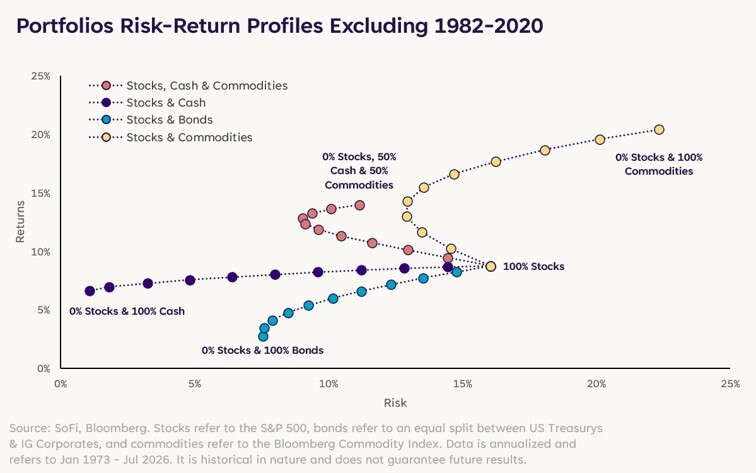
The main takeaway: In a period where inflation is pesky and we expect rates to remain higher for longer, commodities offer a more attractive risk/reward tradeoff than bonds. This doesn’t mean you shouldn’t own bonds at all — bonds can offer attractive income opportunities that commodities can’t. But it does suggest that if you don’t have an allocation to commodities already, now may be a good time to consider one.
There are many ETFs that offer broad commodity exposure such as tickers PDBC or BCI. One thing to be mindful of is that many commodity funds have unique tax structures that generate a Schedule K-1 tax form for investors — which are usually not ready until after the tax deadline and require investors to file for a tax extension, a headache for many. The tickers listed above are structured to not produce a K-1.
In conclusion, we believe we have entered a new era that requires a tweak to our portfolio strategy. Hedging against the evolving risks in this environment is important for any long-term investor, and commodities may offer the diversification benefits we’re looking for.
Disclaimer
SoFi Securities (Hong Kong) Limited and its affiliates (SoFi HK) may post or share information and materials from time to time. They should not be regarded as an offer, solicitation, invitation, advice, recommendation to buy, sell or otherwise deal with any investment instrument or product in any jurisdictions. Keep in mind that investing involves risk, and past performance of an asset never guarantees future results or returns. It’s important for investors to consider their specific financial needs, goals, and risk profile before making an investment decision.
SoFi HK does not make any warranties about the completeness, reliability and accuracy of this information and will not be liable for any losses and/or damages in connection with the use of this information.
The information and materials may contain hyperlinks to other websites, we are not responsible for the content of any linked sites. The information and analysis provided through hyperlinks to third party websites, while believed to be accurate, cannot be guaranteed by SoFi HK. These links are provided for informational purposes and should not be viewed as an endorsement. The risk involved in using such hyperlinks shall be borne by the visitor and subject to any Terms of Use applicable to such access and use.
Any product, logos, brands, and other trademarks or images featured are the property of their respective trademark holders. These trademark holders are not affiliated with SoFi HK or its Affiliates. These trademark holders do not sponsor or endorse SoFi HK or any of its articles.
Without prior written approval of SoFi HK, the information/materials shall not be amended, duplicated, photocopied, transmitted, circulated, distributed or published in any manner, or be used for commercial or public purposes.
Crypto and Crypto ETF products are available only to members in eligible jurisdictions who have successfully completed the required assessments and maintain an appropriate risk profile.
This communication is not directed at, and is not intended for distribution to or use by, any person in the United Kingdom. It does not constitute a financial promotion for the purposes of Section 21 of the Financial Services and Markets Act 2000. This material is not available to any UK Person. By accessing, viewing, or relying on this communication, you represent and warrant that you are not a UK Person and that you are not located in the United Kingdom.


About SoFi Hong Kong
SoFi – Invest. Simple.
SoFi Hong Kong is the All-in-One Super App with stock trading, robo advisor and social features. Trade over 15,000 US and Hong Kong stocks in our SoFi App now.