Why Markets Flail in Fall
Estimated reading time: 5 minutes
September Scaries
A curious thing tends to happen around this time of year: Markets get jumpy.
The seasonal explanation is that investors returning from summer vacations start preparing their portfolios for the remainder of the year. If there’s rebalancing, it can pull money out of top-performing assets.
But this year, although we could have almost cued the jitters, there are more substantive drivers.
The good news is weakness is not broad-based, and the pullback we’ve seen since mid-August is very mild. The bad news is there are a lot of elements creating an unfriendly environment for stocks and bonds right now.
Here are the most prominent of these.
Fall Fed Surprises
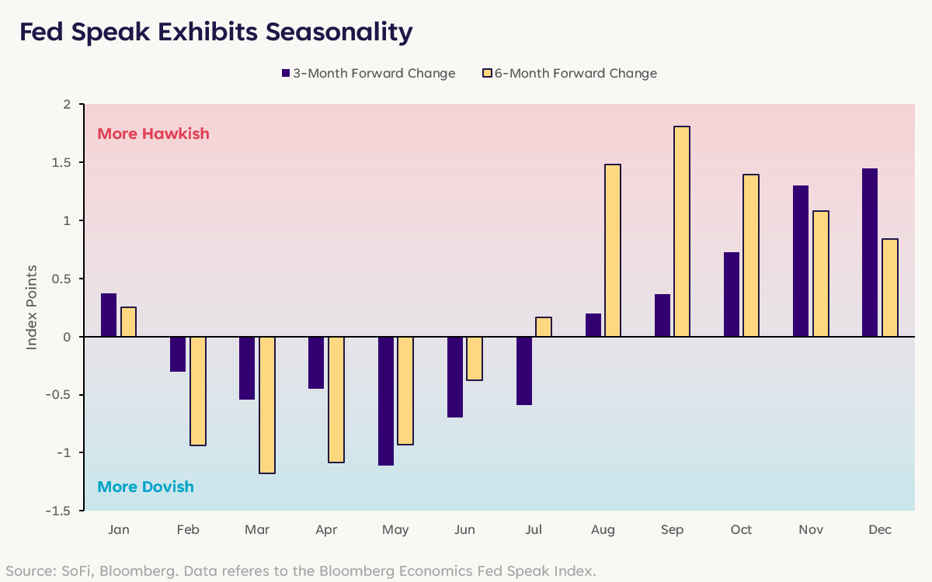
It’s always seemed to us that the Fed tends to surprise or upset markets more often after August. We’ve never dug around for measurable proof of this, it was just a sense we had. So this week we went looking for evidence — and we’re happy to report we’re not imagining things.
We looked at Bloomberg’s Fed Speak Sentiment index, which measures the overall tone of Federal Reserve communications — from dovish to hawkish — over different periods. And as it turns out, the Fed tends to get more hawkish in fall and winter. (Although the upshot didn’t surprise us, the clear and consistent seasonality did.)
The takeaway? The trend of a hawkish fall is bearing out, making markets uncomfortable. Since Chairman Kevin Warsh’s Jackson Hole speech last Friday, the probability of a September rate hike moved from 35% to 67% (as of this writing).
Yield Curve Control
The drama surrounding bond yields has become a real nailbiter. After an uncomfortable rise in long-term Treasury yields, Treasury Secretary Scott Bessent announced a buyback program on Aug.19. It was compared to the Fed’s Operation Twist in 2011, and initially had a similar effect on the yield curve. The 2-year Treasury yield rose slightly while 10- and 30-year yields dropped.
The problem is, it only worked for one day. As of Wednesday, 10-year yields are above where they were before Bessent’s announcement, and 30-year yields are only 2 basis points below where they were.

In our column two weeks ago, we called out the risk that hawkish Fed comments at Jackson Hole could create a tug-of-war between the Fed and the Treasury. Well, here we are. In addition to the old adage “Don’t Fight the Fed,” we may need to internalize “Don’t Fight the Treasury.”
But what should markets do if the two are fighting each other? It’s a tough question to answer. What actually happens when an unstoppable force meets an immovable object? Who knows, but markets have decided to be jumpy. Can’t blame them.
September to Remember
Over the next two weeks, everyone will be back at their desks with sun-kissed skin. (OK, probably not everyone). Investors will need to digest data on jobs and inflation, and both could move markets. Then comes the Fed’s next rate decision, press conference, and updated summary of economic projections on Sept. 16. News about the conflict with Iran will continue to pour in, too.
Here’s to hoping for a month that gives us just enough volatility to keep it interesting and provide opportunities, but not enough to require a column about staying calm during meltdowns.
Disclaimer
SoFi Securities (Hong Kong) Limited and its affiliates (SoFi HK) may post or share information and materials from time to time. They should not be regarded as an offer, solicitation, invitation, advice, recommendation to buy, sell or otherwise deal with any investment instrument or product in any jurisdictions. Keep in mind that investing involves risk, and past performance of an asset never guarantees future results or returns. It’s important for investors to consider their specific financial needs, goals, and risk profile before making an investment decision.
SoFi HK does not make any warranties about the completeness, reliability and accuracy of this information and will not be liable for any losses and/or damages in connection with the use of this information.
The information and materials may contain hyperlinks to other websites, we are not responsible for the content of any linked sites. The information and analysis provided through hyperlinks to third party websites, while believed to be accurate, cannot be guaranteed by SoFi HK. These links are provided for informational purposes and should not be viewed as an endorsement. The risk involved in using such hyperlinks shall be borne by the visitor and subject to any Terms of Use applicable to such access and use.
Any product, logos, brands, and other trademarks or images featured are the property of their respective trademark holders. These trademark holders are not affiliated with SoFi HK or its Affiliates. These trademark holders do not sponsor or endorse SoFi HK or any of its articles.
Without prior written approval of SoFi HK, the information/materials shall not be amended, duplicated, photocopied, transmitted, circulated, distributed or published in any manner, or be used for commercial or public purposes.
Crypto and Crypto ETF products are available only to members in eligible jurisdictions who have successfully completed the required assessments and maintain an appropriate risk profile.
This communication is not directed at, and is not intended for distribution to or use by, any person in the United Kingdom. It does not constitute a financial promotion for the purposes of Section 21 of the Financial Services and Markets Act 2000. This material is not available to any UK Person. By accessing, viewing, or relying on this communication, you represent and warrant that you are not a UK Person and that you are not located in the United Kingdom.


About SoFi Hong Kong
SoFi – Invest. Simple.
SoFi Hong Kong is the All-in-One Super App with stock trading, robo advisor and social features. Trade over 15,000 US and Hong Kong stocks in our SoFi App now.