Looking at: The Makings of a Melt-Up
Estimated reading time: 6 minutes
Feeding the Market Fire
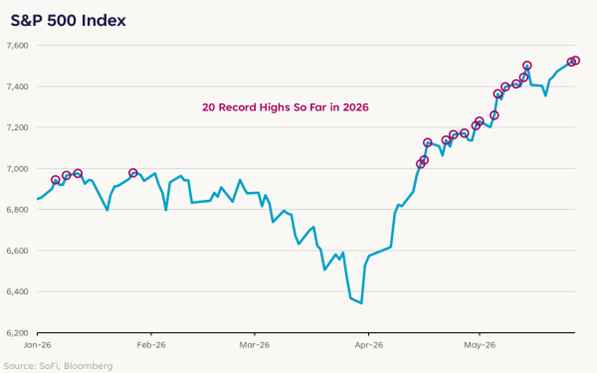
In a sharp turnaround from two months ago, U.S. stocks have been on an absolute tear, with the S&P 500 reaching numerous record highs in recent weeks. Fears that the benchmark would fall below 6,000 have evaporated and now sell-side research firms are rushing to issue year-end targets of 8,000 or more.
The magnitude of the rebound has been dizzying, which naturally triggers some FOMO (fear of missing out) for investors. Given positioning hasn’t been all-out bullish, some have been left underinvested, and as we know it’s not fun watching high-flying stocks surge week after week without getting a taste. That’s led to an increasing willingness to chase stocks with strong momentum.
Of course, it’s not just sentiment that’s feeding market fire.
Expectations for a permanent peace deal between the U.S. and Iran have been a recurring pillar of support over the last two months, boosting stocks and lowering oil prices. A breakthrough in the war would help remove the main macroeconomic headwind left on the board: the disruption in global oil supplies.
Lower energy prices would free up money for both businesses and consumers alike. That, in turn, would boost real economic growth and ease some of the inflation concerns currently gripping the market. And the Federal Reserve would probably do less of whatever it might have to do with interest rates if the oil shock persists.
Combine this improving geopolitical backdrop, robust earnings growth, and a technological boom that shows no signs of slowing, and what do you have? The ingredients for a market “melt-up.” There’s no one definition of a melt-up, of course, but let’s just say it’s a rapid increase in asset prices — one where people are FOMO buying because prices are rising and there’s little fear of the bear case.
When the last remaining market bears throw in the towel and macro headwinds dissipate, the resulting vacuum can propel stocks to valuations that detach from historical norms. The conditions for such a melt-up are building.
Ground Zero of Exuberance
Although sentiment can boost stocks, it’s hard to have a true melt-up without a tangible, fundamental why. Artificial intelligence has been that why for multiple years now, and the infrastructure buildout continues to show little sign of slowing down.
Look no further than the Semiconductor & Tech Hardware space, where multiple memory-chip makers have seen their market capitalizations soar past $1 trillion. If it’s linked to data storage and processing power, money is being thrown at it. Take the launch of the Roundhill Memory ETF (DRAM) for example: Despite launching in April, it’s already reached $10 billion in AUM, easily shattering the record for most successful ETF launch in history.
AI dominance has benefited the Information Technology sector — and the underlying Semiconductor & Tech Hardware industry groups — becoming increasingly influential to the movement of the broader market. Those two industry groups now make up nearly 29% of the overall S&P 500, by far the biggest share since 1990. And it’s still on a sharp upward trend.
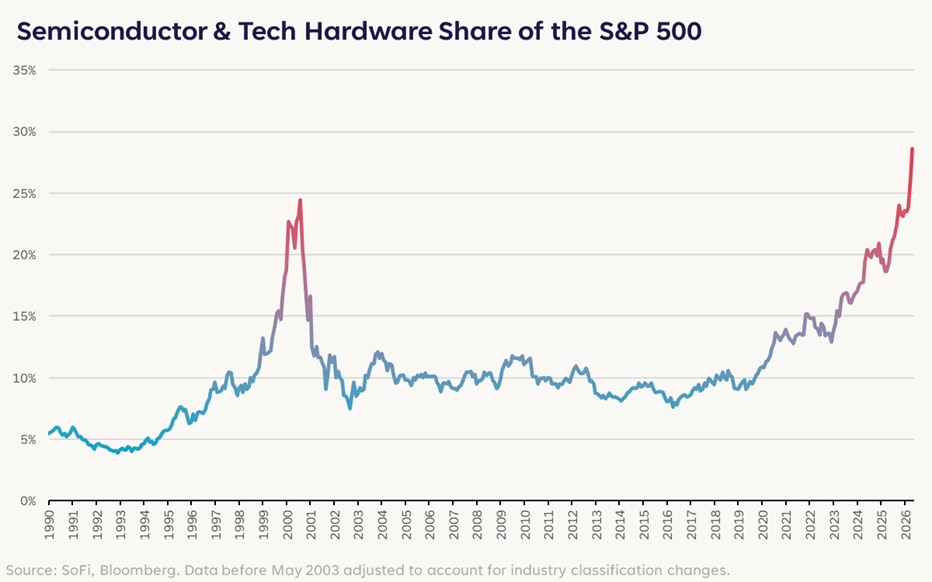
This means that while S&P 500 index investors do get exposure to a diverse set of companies, they are increasingly invested in a high-flying theme that is prone to volatility even while long-term in nature.
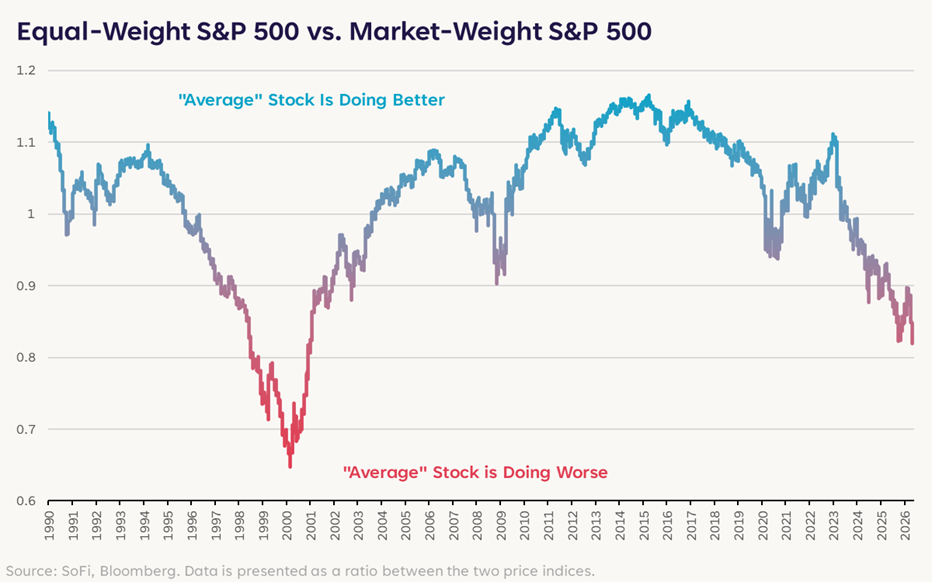
The concentration is clearly reflected in investment performance. The market-cap-weighted S&P 500 is massively outpacing its equal-weighted counterpart. Strategists like to call out how the “average” stock is doing as a way to isolate breadth and/or durability in the market. While not everyone agrees that breadth is necessary for a market to keep rallying, it’s clear that this has been a market defined by the AI haves and the AI have-nots.
Checking Your Emotions
Times like these are exactly why portfolio rebalancing (aka selling high and buying low) is a thing. In today’s market, that would mean selling tech stocks, given they’re having their best quarter since 2001, and buying bonds or Utilities stocks (or whatever you want to hold on to that’s performed poorly).
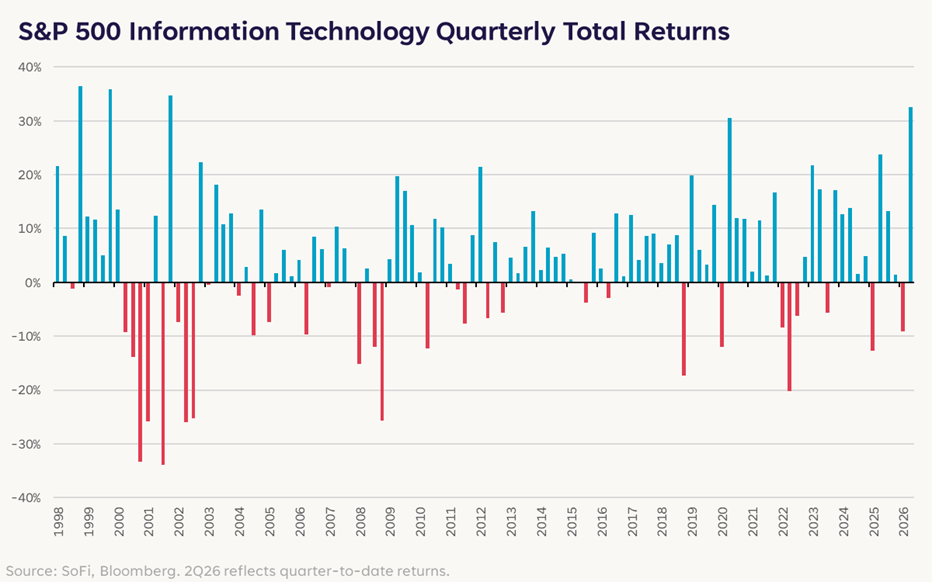
This might feel counterintuitive in a melt-up environment, though. After all, market momentum has favored tech concentration since late-2022, so why go against your winners and bet on underperformers?
In the past, we’ve discussed something called the “disposition effect” This is the tendency investors have to sell winning investments too quickly while not selling losing investments quickly enough. It’s an important lesson and bias to be aware of, but it’s equally valuable to not misapply these principles. Full-blown market melt-ups can inflate valuations and expectations beyond what fundamentals support, and letting your secular winners run is not the same thing as never taking profits or forgoing diversification. It’s OK to take some chips off the table.
Periods of heightened emotion, both high and low, can lead to poor investment decisions. Rebalancing is one way to put a lid on those emotions and manage risk prudently. How exactly that looks will be different for everyone, but it’s a time-tested practice for a reason.
Disclaimer
SoFi Securities (Hong Kong) Limited and its affiliates (SoFi HK) may post or share information and materials from time to time. They should not be regarded as an offer, solicitation, invitation, advice, recommendation to buy, sell or otherwise deal with any investment instrument or product in any jurisdictions. Keep in mind that investing involves risk, and past performance of an asset never guarantees future results or returns. It’s important for investors to consider their specific financial needs, goals, and risk profile before making an investment decision.
SoFi HK does not make any warranties about the completeness, reliability and accuracy of this information and will not be liable for any losses and/or damages in connection with the use of this information.
The information and materials may contain hyperlinks to other websites, we are not responsible for the content of any linked sites. The information and analysis provided through hyperlinks to third party websites, while believed to be accurate, cannot be guaranteed by SoFi HK. These links are provided for informational purposes and should not be viewed as an endorsement. The risk involved in using such hyperlinks shall be borne by the visitor and subject to any Terms of Use applicable to such access and use.
Any product, logos, brands, and other trademarks or images featured are the property of their respective trademark holders. These trademark holders are not affiliated with SoFi HK or its Affiliates. These trademark holders do not sponsor or endorse SoFi HK or any of its articles.
Without prior written approval of SoFi HK, the information/materials shall not be amended, duplicated, photocopied, transmitted, circulated, distributed or published in any manner, or be used for commercial or public purposes.


About SoFi Hong Kong
SoFi – Invest. Simple.
SoFi Hong Kong is the All-in-One Super App with stock trading, robo advisor and social features. Trade over 15,000 US and Hong Kong stocks in our SoFi App now.