Looking at: Rising Risks and the Urge to Freak Out
Estimated reading time: 6 minutes
The Stakes Get Higher
We’re in week two of conflict in the Middle East. Since last week’s column, oil nearly reached $120/bbl on Sunday night as supply disruption concerns collided with low overnight liquidity. It then fell below $90/bbl Monday afternoon after US President Trump said the war could be ending soon. That’s a swing of over 30% in a single day. Though prices are still around $90/bbl as of this writing, the Strait of Hormuz remains effectively closed and a risk to global markets.
Last week we shared this chart comparing oil price shocks throughout history. As you can see, the update shows the increased magnitude of this one. The spike that occurred over the weekend brought the current move into uncomfortable territory.
The stock market has been understandably on edge, with most S&P 500 sectors in the red over the past week and groups such as Materials, Consumer Durables, and Transportation taking a particularly rough beating. Even Consumer Staples, a typically defensive sector, has been hit due to the expectation of higher energy costs.
Periods like this are incredibly uncomfortable and impossible to predict. As investors, perhaps the most unsettling piece is feeling like we are at the mercy of the news cycle. You’re not alone if that’s how you’re feeling.
What We Can Do
Although we can’t know when or how this ends, we can consider whether or not it’s time to reevaluate our investment stance.
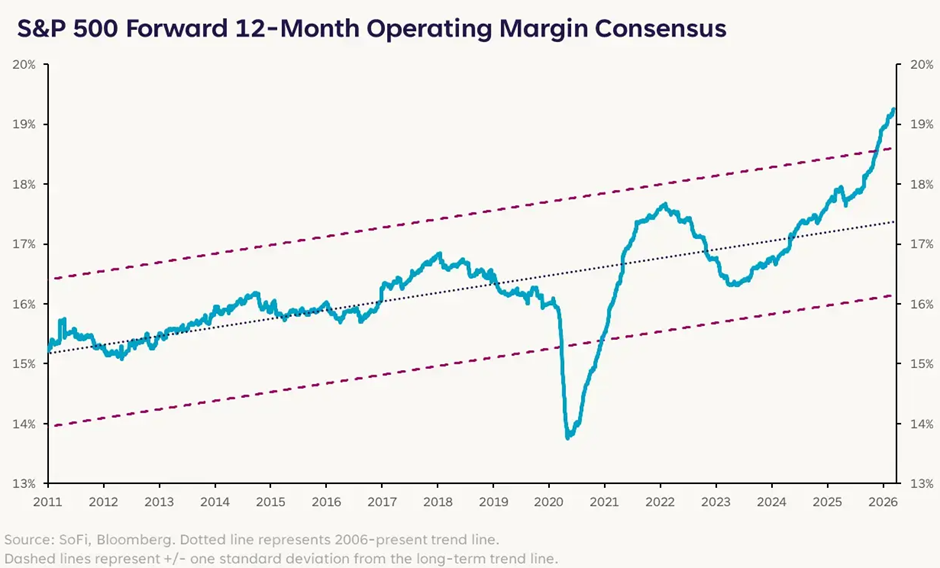
The expectation of rising energy costs is currently pressuring stock prices, but at this point it’s still an estimate of how much costs might pressure operating margins. And here’s some good news: Margins for the S&P 500 are currently quite strong. In fact, they’re running markedly above trend. To me that means two things: 1) We have a decent buffer before this becomes problematic, and 2) It’s unlikely that the stock market experiences a prolonged or deep drawdown if margins are healthy and rising.
That said, higher energy costs would take time to show up in these metrics. And a prolonged period of higher energy prices could materially affect company margins. We just don’t know yet if that will be the case.
In the meantime, as we approach the end of the first quarter, we can watch operating margins for signs of deterioration.
Get Out Your Levels
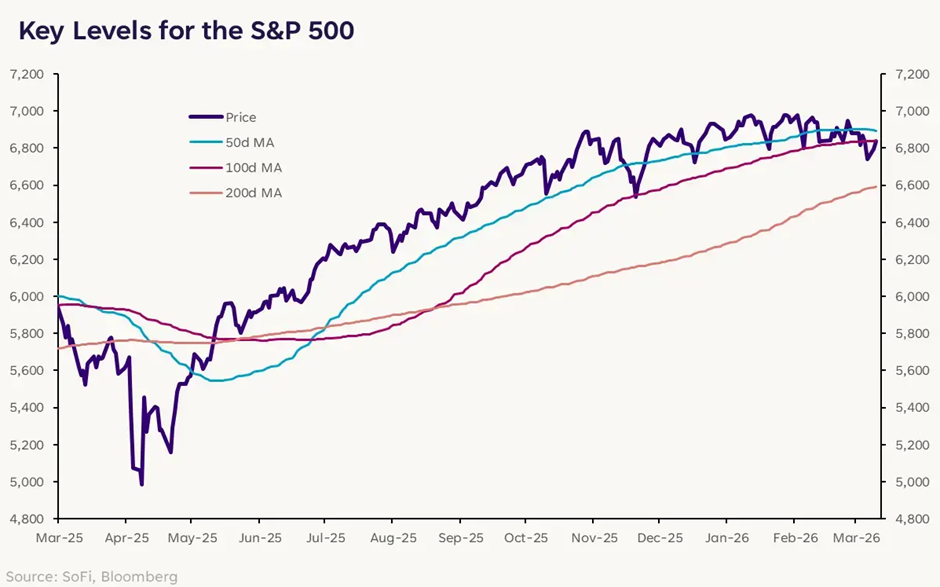
On a more near-term basis, there are certain market levels that we’ll be watching as a litmus test of investor sentiment. It’s important to note that these levels are not buy or sell signals, they’re simply measures of how washed out things have gotten and possible ranges where the market might find some more solid footing.
It’s also important to keep things in perspective: The S&P hit a new all-time high of 7,002 on Jan 28, and even with the recent pullback, it’s only been a 5% drop at its worst. We haven’t entered “correction” territory yet, which is generally considered a pullback of at least 10%.
Nevertheless, we’re paying attention to moving averages to measure the severity of the current drawdown and to hone in on where we’d like to see the index bounce back. The S&P 500 is currently trading below its 50- and 100-day moving averages, but those are shorter-term measures and can be easy for the index to briefly drop below during periods of volatility.
The 200-day moving average is an important line to watch. The market technicians I follow closely are all watching that for the next level of support if the market continues to pull back. And the index remains comfortably above the 200-day moving average at the moment.
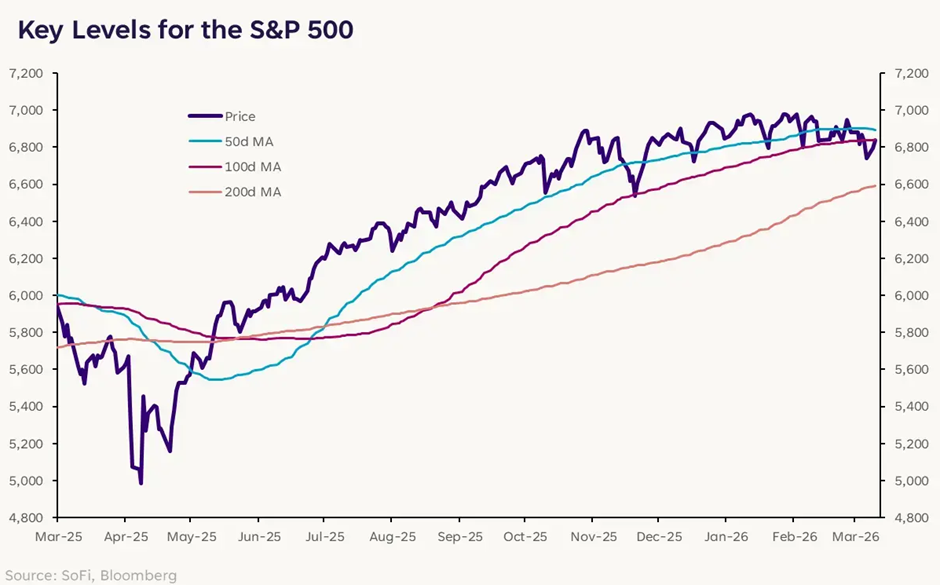
If we do approach the 200-day moving average, the hope is that the drawdown may have exhausted itself and could bounce off of it. Time will tell – but one of the things that tends to be true in markets is that you have to let the flush fully play out before expecting a durable recovery.
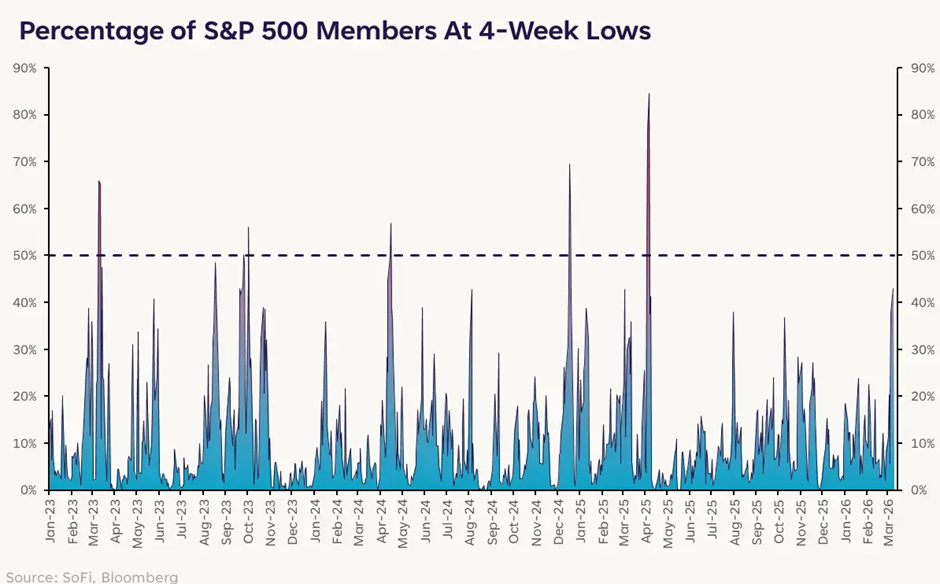
One other metric watched closely by Chris Verrone, a market technician at Strategas Research Partners, is the percent of stocks trading at 20-day lows. He posits that a flush is fully flushed when this hits 50%. We’re not there yet, but we’re getting closer.
Do the Harder Thing
One of our values at SoFi is “Do the right thing: If you’re not sure, do the harder thing.” This is a time when one thing’s for sure: None of us are sure. Following this rule, we should do the harder thing.
Of course, the harder thing may differ for each of us, but generally speaking investors have a very hard time sitting still in times like these. Doing something creates the illusion that we have some control over a very challenging situation. For others, the harder thing is to think about buying parts of the market that have been hit.
Either way, the harder thing is to avoid “freaking out.” I have never known an investor who felt better after acting on their freak outs. Watch the signals, watch the levels, and keep things in perspective. We will do the same, and update you as we go. Hang in there.
Disclaimer
SoFi Securities (Hong Kong) Limited and its affiliates (SoFi HK) may post or share information and materials from time to time. They should not be regarded as an offer, solicitation, invitation, advice, recommendation to buy, sell or otherwise deal with any investment instrument or product in any jurisdictions. Keep in mind that investing involves risk, and past performance of an asset never guarantees future results or returns. It’s important for investors to consider their specific financial needs, goals, and risk profile before making an investment decision.
SoFi HK does not make any warranties about the completeness, reliability and accuracy of this information and will not be liable for any losses and/or damages in connection with the use of this information.
The information and materials may contain hyperlinks to other websites, we are not responsible for the content of any linked sites. The information and analysis provided through hyperlinks to third party websites, while believed to be accurate, cannot be guaranteed by SoFi HK. These links are provided for informational purposes and should not be viewed as an endorsement. The risk involved in using such hyperlinks shall be borne by the visitor and subject to any Terms of Use applicable to such access and use.
Any product, logos, brands, and other trademarks or images featured are the property of their respective trademark holders. These trademark holders are not affiliated with SoFi HK or its Affiliates. These trademark holders do not sponsor or endorse SoFi HK or any of its articles.
Without prior written approval of SoFi HK, the information/materials shall not be amended, duplicated, photocopied, transmitted, circulated, distributed or published in any manner, or be used for commercial or public purposes.


About SoFi Hong Kong
SoFi – Invest. Simple.
SoFi Hong Kong is the All-in-One Super App with stock trading, robo advisor and social features. Trade over 15,000 US and Hong Kong stocks in our SoFi App now.