Looking At: Oil, Conflict, and Uncertainty
Estimated reading time: 6 minutes
All You Can Eat Uncertainty
The conflict that erupted in the Middle East over the past week has presented a new set of challenges and uncertainty for the global economy and markets. Unfortunately, markets were already on edge because of the recent sell-off in software stocks, crypto and private credit companies.
So far, Energy stocks have performed well due to the rise in oil prices, but other cyclical groups such as Materials, Financials, and Discretionary have been hit by the uncertainty. Investors are jumpy and emotional, which is to be expected.
So, let’s explore how shocks of this type have played out in the past, and where the major risks and opportunities for investors can be found.
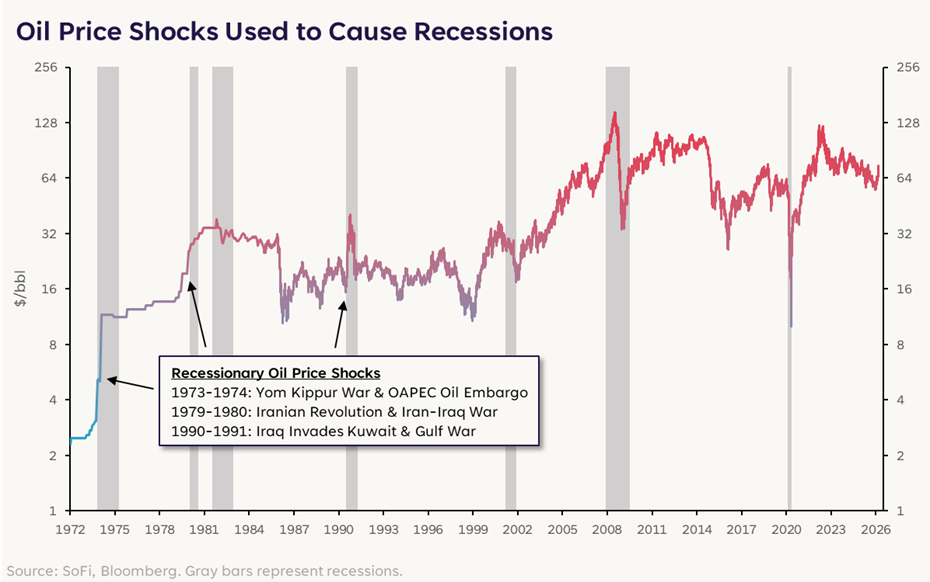
Due to supply disruptions, oil prices have risen from about $65/barrel pre-conflict, to nearly $75/barrel as of Wednesday. This is a small move compared to previous oil shocks — when we saw prices as much as quadruple — but it’s possible we haven’t seen the peak yet.
A sustained rise in oil prices affects inflation, consumer spending, and investor confidence. What’s increasing the jitters is the fact that a spike in oil prices has preceded, and even caused, some recessions.
The good news, however, is that this hasn’t been the case in more recent recessions.
In the chart below, we’ve indicated the times when an oil price shock was a notable recession driver. Note the logarithmic scale on the vertical axis, which helps show the relative magnitude of moves (e.g. going from $65 to $74, a 14% increase, doesn’t have the same impact as going from $3 to $12, a 300% increase).
In other words, it’s not a given that a shock will result in recessionary forces. The important elements to watch are how large the shock is — this one feels big right now, but it’s not as big as we’ve seen in the past — and how long it lasts. So far we’re less than one week in.
Strong Spots and Weak Spots
One major positive development since the recessions of the 1970s and 80s, which were instigated by oil shocks, is that the U.S. is much more self-sufficient when it comes to oil production today. This leaves us much less sensitive to Middle Eastern supply dislocations. In fact, the U.S., a major importer of petroleum as recently as 2005, is now a net exporter of petroleum.
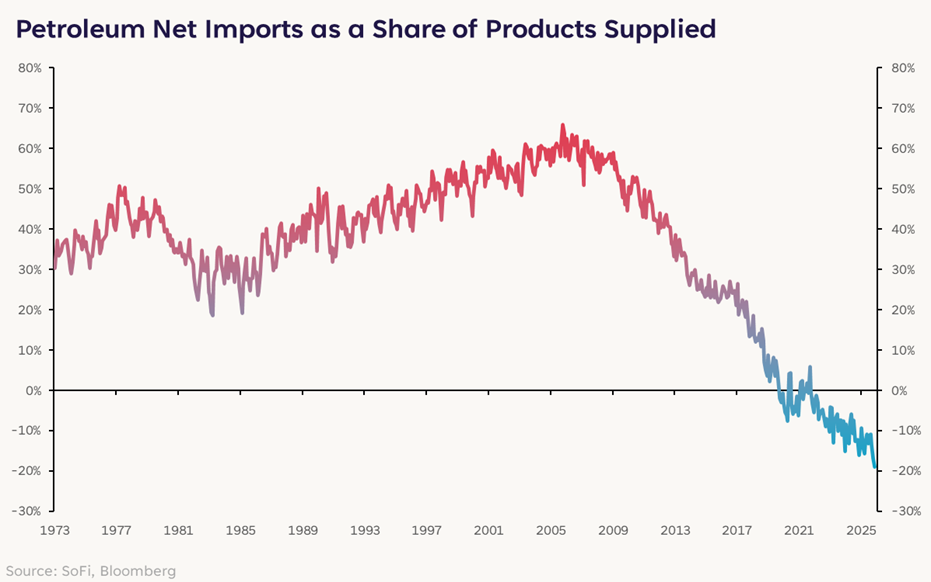
This shift doesn’t make us invincible, but it certainly reduces the economic impact. That said, if this conflict continues without deescalation for weeks or months — keeping oil prices higher for longer — our main concern will be the pressure on consumers and its effect on inflation and monetary policy. Markets are already sniffing around this risk by driving inflation breakevens higher and expectations of additional Federal Reserve interest rate cuts lower.
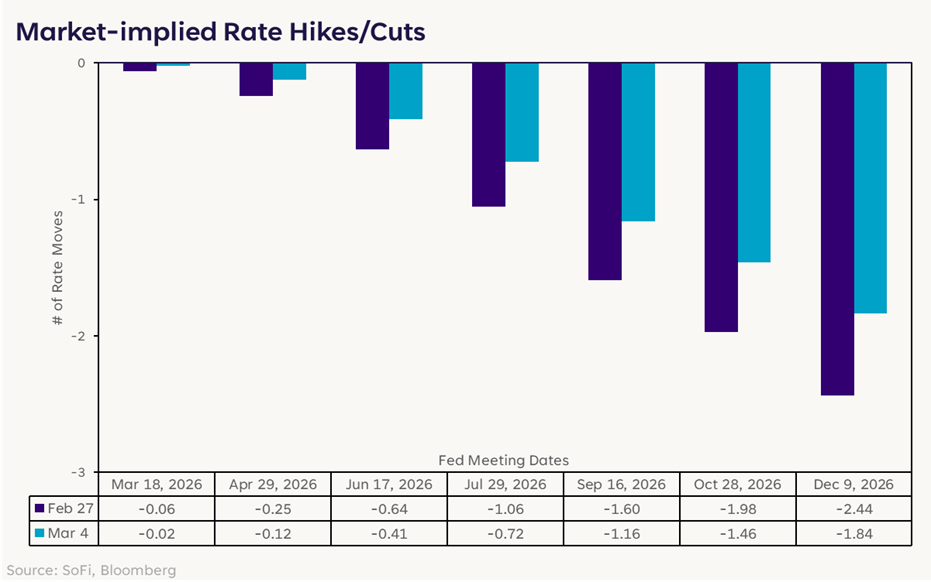
It’s no secret that the stock market in the U.S. has celebrated the prospect of rate cuts for most of this cycle, so fewer cuts are not exactly on its wish list. But it’s been my opinion for some time that this market doesn’t need rate cuts in 2026 to remain resilient. If the labor market and economic growth are stable and/or strong, there isn’t much justification for cuts from a monetary policy perspective, particularly if inflation stays above the 2% target or is rising.
How Might the Market Respond?
It’s worth looking at which industry groups have done well during previous oil shocks, which we’re defining as when oil prices are either at least 20% above their two-year average or their four-month low.
Shown below are the top 10 industries by monthly return during the shock. Perhaps not surprisingly, defensive groups such as healthcare make the cut, as do industries that can actually benefit from a rise in oil prices such as coal and petroleum.
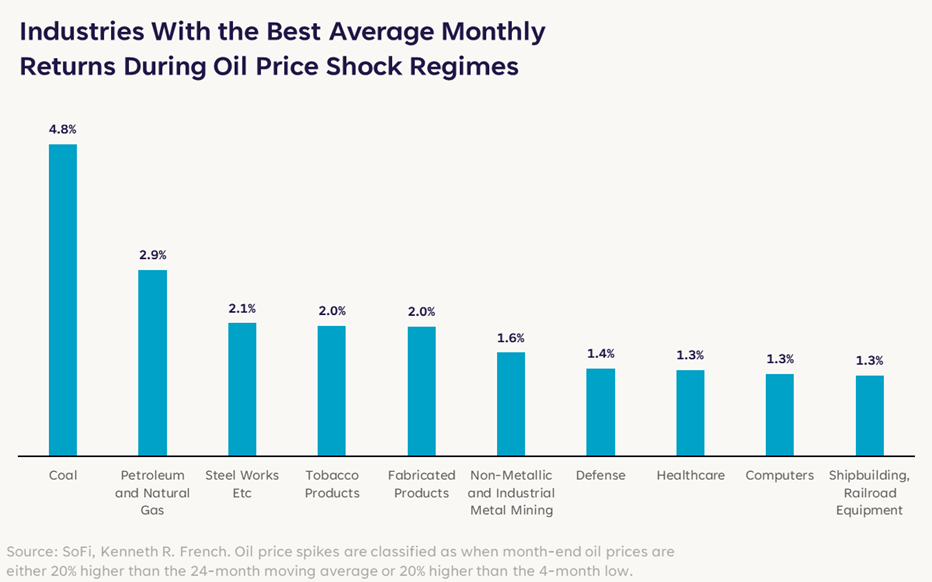
Then at the bottom are economically sensitive industries such as recreation and hospitality. These shouldn’t be taken as clear buy or sell ideas, since we are still early in this conflict and the spike in oil prices isn’t dramatic by historical standards… yet. But they can give you a sense of where we can expect higher volatility or better stability in markets during this episode.
We would urge investors to stay the course for their long-term goals and try not to race other investors out the door. In the short-term, markets tend to overreact on the upside and the downside, meaning swift moves can partially reverse quickly. We are monitoring the situation closely and will provide updates as things progress, but for now, we continue to believe that the best reaction is not to react.
Disclaimer
SoFi Securities (Hong Kong) Limited and its affiliates (SoFi HK) may post or share information and materials from time to time. They should not be regarded as an offer, solicitation, invitation, advice, recommendation to buy, sell or otherwise deal with any investment instrument or product in any jurisdictions. Keep in mind that investing involves risk, and past performance of an asset never guarantees future results or returns. It’s important for investors to consider their specific financial needs, goals, and risk profile before making an investment decision.
SoFi HK does not make any warranties about the completeness, reliability and accuracy of this information and will not be liable for any losses and/or damages in connection with the use of this information.
The information and materials may contain hyperlinks to other websites, we are not responsible for the content of any linked sites. The information and analysis provided through hyperlinks to third party websites, while believed to be accurate, cannot be guaranteed by SoFi HK. These links are provided for informational purposes and should not be viewed as an endorsement. The risk involved in using such hyperlinks shall be borne by the visitor and subject to any Terms of Use applicable to such access and use.
Any product, logos, brands, and other trademarks or images featured are the property of their respective trademark holders. These trademark holders are not affiliated with SoFi HK or its Affiliates. These trademark holders do not sponsor or endorse SoFi HK or any of its articles.
Without prior written approval of SoFi HK, the information/materials shall not be amended, duplicated, photocopied, transmitted, circulated, distributed or published in any manner, or be used for commercial or public purposes.


About SoFi Hong Kong
SoFi – Invest. Simple.
SoFi Hong Kong is the All-in-One Super App with stock trading, robo advisor and social features. Trade over 15,000 US and Hong Kong stocks in our SoFi App now.