Looking At: Momentum Vibes
Estimated reading time: 5 minutes
Wind at Some Backs
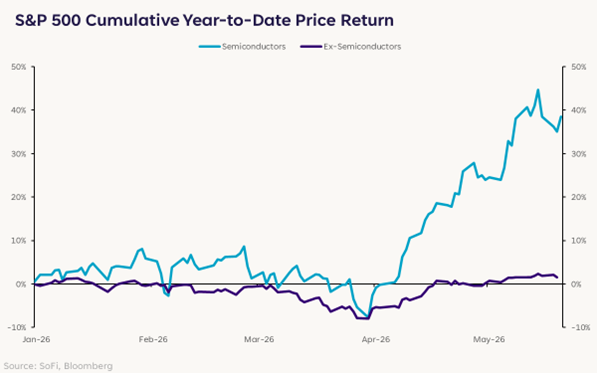
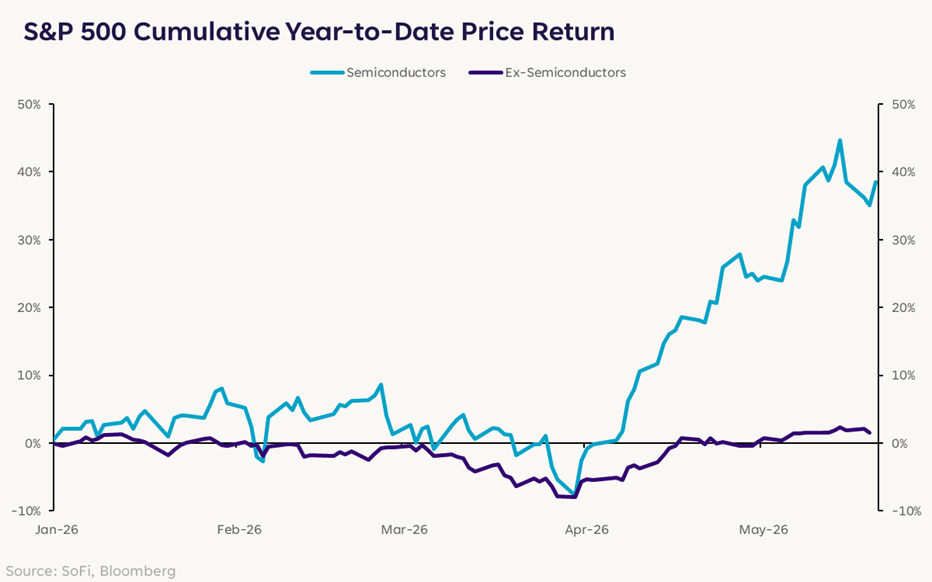
Even though the S&P 500 crossed over 7,500 for the first time on May 14, only 55% of stocks were above their 200-day moving averages. In other words, the index has ripped higher since its recent low at the end of March, but once again, the gains are concentrated in a few industry groups.
This isn’t necessarily cause for alarm, but it does make the rally more fragile while we depend on a narrow basket of stocks to prop up returns and earnings growth. And for the market technicians out there, parabolic moves in industry groups like semiconductors can be more susceptible to quick and sharp pullbacks as things become overbought.
When the bond market and interest rate expectations took a bite out of the semiconductor rally over the past week, investors responded by buying the dip. A 10% correction spanned less than three trading days, and semis are still up a whopping 62% since March 30!
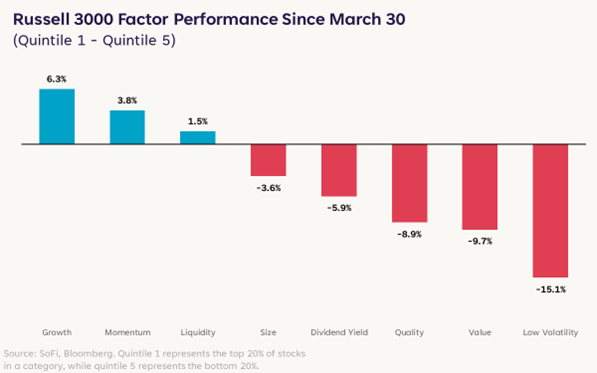
Looking at markets through a factor lens, we can see Growth and Momentum far outpacing factors like low volatility and value in recent weeks. Momentum can be a very powerful force in both directions, but I believe it will take more than a couple hot inflation reports and yields grinding higher to meaningfully shift the lens away from high-flying stocks.
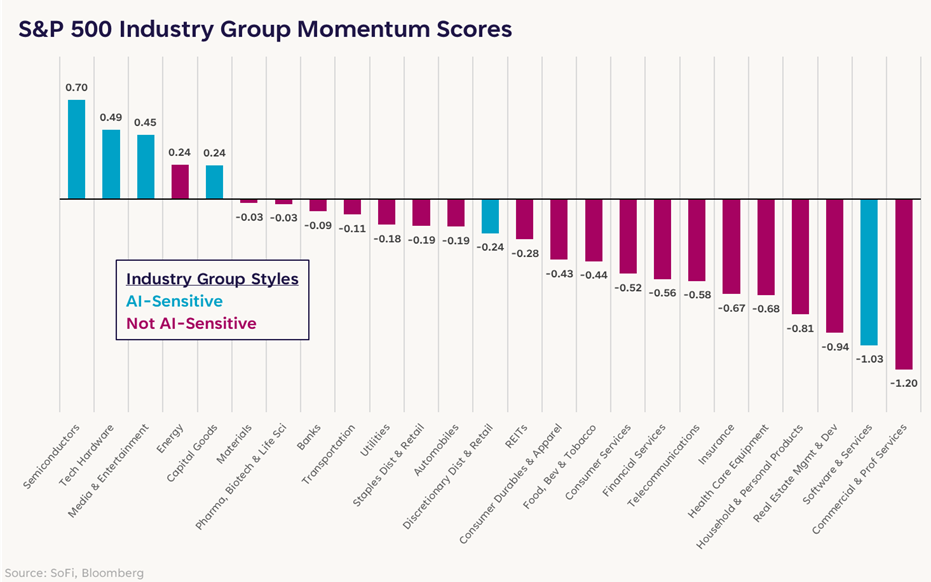
To further illustrate how concentrated market leadership has been, we can look at the industry groups with the strongest momentum scores. Of the 25 groups in total, only five are currently registering positive momentum scores. Energy is the only non-tech group that’s meaningfully positive, which makes sense given the ongoing oil shock.
Corrective Lenses
This narrow leadership is a reason to evaluate your positioning and make sure your portfolio isn’t too exposed to recent parabolic moves. It’s also an opportunity to lock in some gains and perhaps manage tax consequences by harvesting some losses.
That said, it’s clear to me that this market continues to have tunnel vision on the AI buildout and potential upside in related stocks. Of course, there continue to be risks: inflation, global oil supply, geopolitical tension, and political forces (as the midterm elections draw nearer.) Nevertheless, earnings growth and continued strong guidance from AI-exposed companies has proven to be a stronger force than these risks.
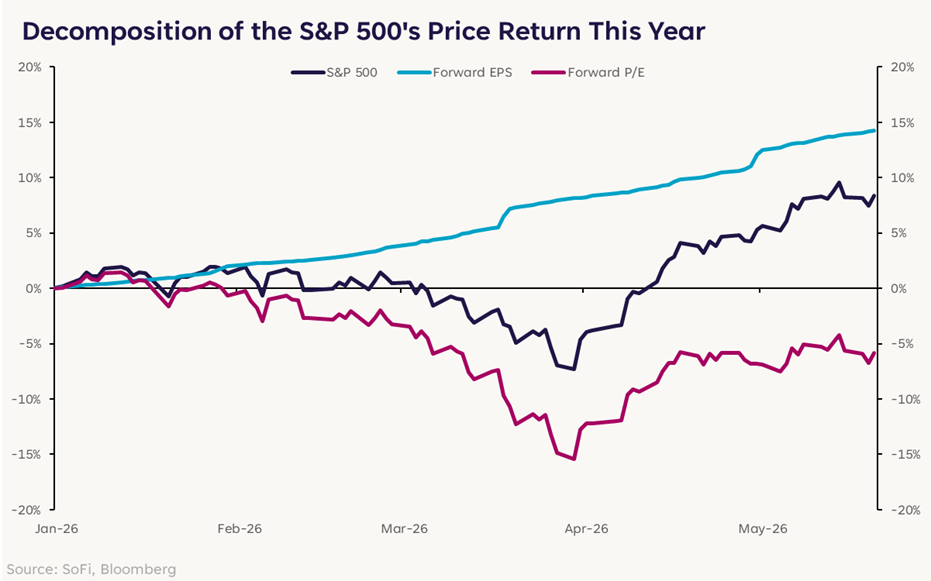
And let’s not forget that one of our main concerns in 2025 was how high valuation multiples were. This year, valuations have actually compressed due to incredibly strong earnings growth. The chart below shows the S&P 500 price return (black), forward earnings growth (light blue), and the corresponding price-to-earnings (P/E) ratio. As you can see, consensus forward earnings growth (denominator) has outpaced price growth (numerator), which effectively lowered the forward P/E ratio by 6%.
That may seem counterintuitive in a period when both price and earnings rose, but the P/E ratio is a function of how quickly each is growing. As such, I would argue that what’s happened with P/E ratios this year has actually made the bubble look less… bubbly.
Do I believe we’ll see corrections that spook investors during this AI-driven hype in markets? Yes. Are fundamentals still in place to support upward momentum in technology and growth stocks? Also yes.
It may be a bubble. It may at some point pop and we’ll all look back in the rearview mirror pointing toward the warning signs. But in the meantime, one of our main goals as investors is to pursue capital appreciation. In order to do so, we have to maintain some exposure to the parts of the market that are producing most of that growth. Just make sure you’re taking gains along the way, and redistributing them into other parts of the market that haven’t gone parabolic.
Disclaimer
SoFi Securities (Hong Kong) Limited and its affiliates (SoFi HK) may post or share information and materials from time to time. They should not be regarded as an offer, solicitation, invitation, advice, recommendation to buy, sell or otherwise deal with any investment instrument or product in any jurisdictions. Keep in mind that investing involves risk, and past performance of an asset never guarantees future results or returns. It’s important for investors to consider their specific financial needs, goals, and risk profile before making an investment decision.
SoFi HK does not make any warranties about the completeness, reliability and accuracy of this information and will not be liable for any losses and/or damages in connection with the use of this information.
The information and materials may contain hyperlinks to other websites, we are not responsible for the content of any linked sites. The information and analysis provided through hyperlinks to third party websites, while believed to be accurate, cannot be guaranteed by SoFi HK. These links are provided for informational purposes and should not be viewed as an endorsement. The risk involved in using such hyperlinks shall be borne by the visitor and subject to any Terms of Use applicable to such access and use.
Any product, logos, brands, and other trademarks or images featured are the property of their respective trademark holders. These trademark holders are not affiliated with SoFi HK or its Affiliates. These trademark holders do not sponsor or endorse SoFi HK or any of its articles.
Without prior written approval of SoFi HK, the information/materials shall not be amended, duplicated, photocopied, transmitted, circulated, distributed or published in any manner, or be used for commercial or public purposes.


About SoFi Hong Kong
SoFi – Invest. Simple.
SoFi Hong Kong is the All-in-One Super App with stock trading, robo advisor and social features. Trade over 15,000 US and Hong Kong stocks in our SoFi App now.