Whether the Fed Should Hike Rates
Estimated reading time: 7 minutes
To Hike, Or Not to Hike
We’re not going to bury the lede here: We do not think the Federal Reserve will hike interest rates at its September meeting. We also don’t think it should hike rates at its October meeting. We’ll even take it one step further and say that by the Fed’s December meeting, we think the economic data will have cooled enough to reduce the rate-hiking chatter altogether.
These are bold assertions — and some may say it’s too early to make them — but so be it. Although we respect Chairman Kevin Warsh’s public commitment to the Fed’s 2% inflation target, we believe there is more risk in hiking rates than not. A rate hike now would suggest a hiking cycle that doesn’t stop until inflation reaches that target. And the economy is not strong enough to withstand that.
It’s important to note that as of Wednesday, the market disagrees with us. Market pricing shows a 61% probability of a rate hike at the September meeting. So basically we expect one of two things: The probability comes down over the next week, or the market gets surprised on Sept. 16.
Now, we should note that the Consumer Price Index for August comes out on Friday. And if you’re wondering why we’d make such a bold statement before we have the latest inflation data, that’s a fair question.
Our answer is that we don’t think the next inflation print is the only deciding factor. In fact, we expect the next inflation print to be hot given the continued conflict in the Middle East and the resulting resurgence in oil prices. And yet we still don’t think they should hike rates.
Fear the Later Hikes, Not the First
The natural pushback We’ve already gotten is that one 25-basis-point hike isn’t going to do much. That is absolutely true, and we agree. But it’s not that first hike that We’d be worried about. It’s the expectation of subsequent hikes, and the idea that a hiking cycle could be the beginning of the end for this market rally.
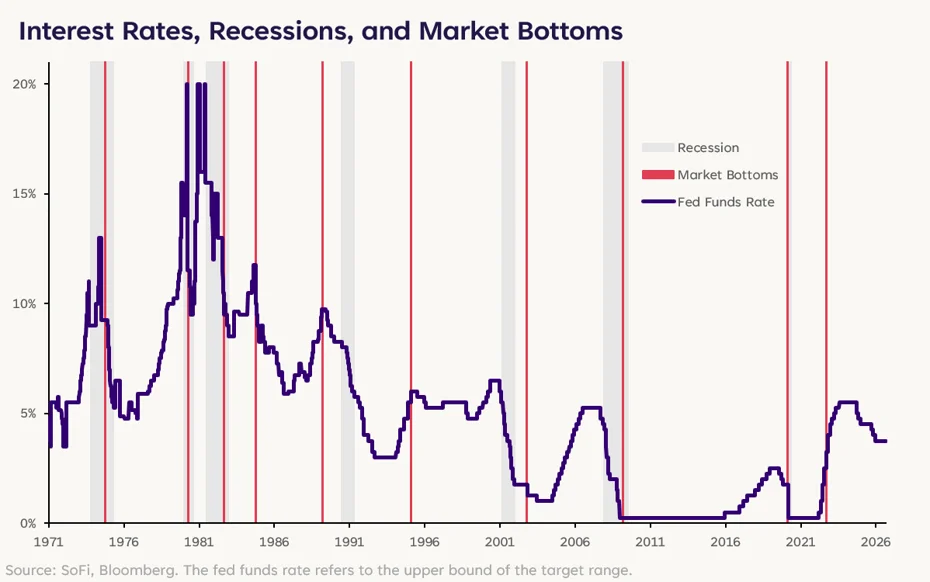
The old saying we’re hearing a lot lately is, “Bull markets don’t die of old age, they’re killed by the Fed.” Sayings like that last through economic cycles because when we look back, they tend to be true. Every cycle is a little bit different, of course, but research from Strategas shows that it’s rarely the first hike that causes problems for markets: In 1987, it was the third hike that caused issues, and in 2000, it was the fifth. It’s the concept behind the old “three steps and a stumble” rule of thumb, popularized by Edson Gould and Marty Zweig Catchy.
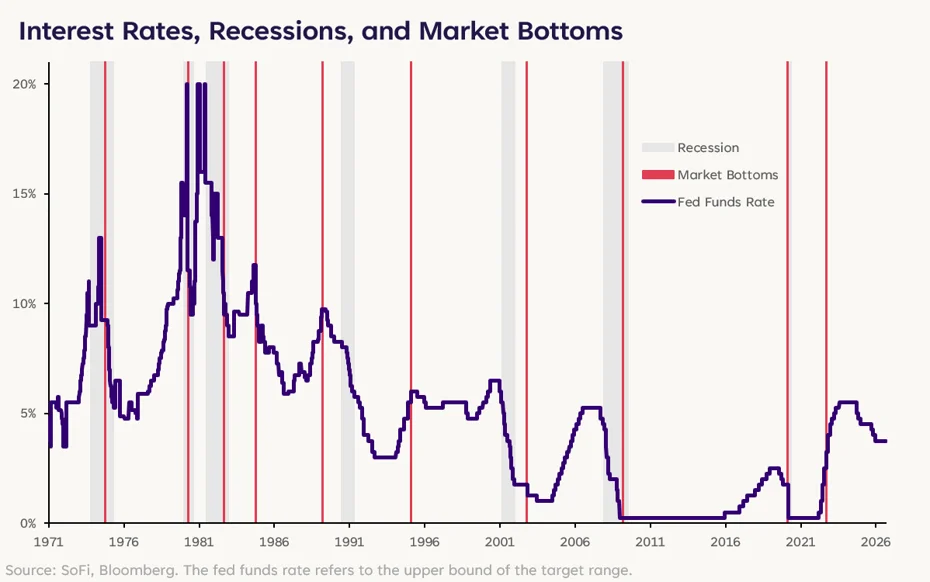
Averages are not scientific predictions, but they do help us identify patterns that have repeated over time. The main takeaway of the chart above is that a bull market trend can continue for the first couple hikes, but as the cycle lengthens, markets tend to break down. And as we’ve mentioned before, we are of the mind that this time is never different.
Let’s draw another parallel to the late 90s.
After holding rates steady for a year and a half between 1997 and 1998, the Fed cut rates three times as the hedge fund Long-Term Capital Management was collapsing and global markets were in upheaval in late summer of 1998.
If the closest parallel today is Situational Awareness’s collapse this past July, we can see what happened when the Fed began hiking rates in June 1999. The S&P continued to rise, but grew quite choppy just before the third rate hike of that cycle. The market hit its peak in March 2000 — just after the fifth rate hike — but the Fed went on to hike one more time, by 50 basis points, in May 2000. By then the S&P had already lost its footing.
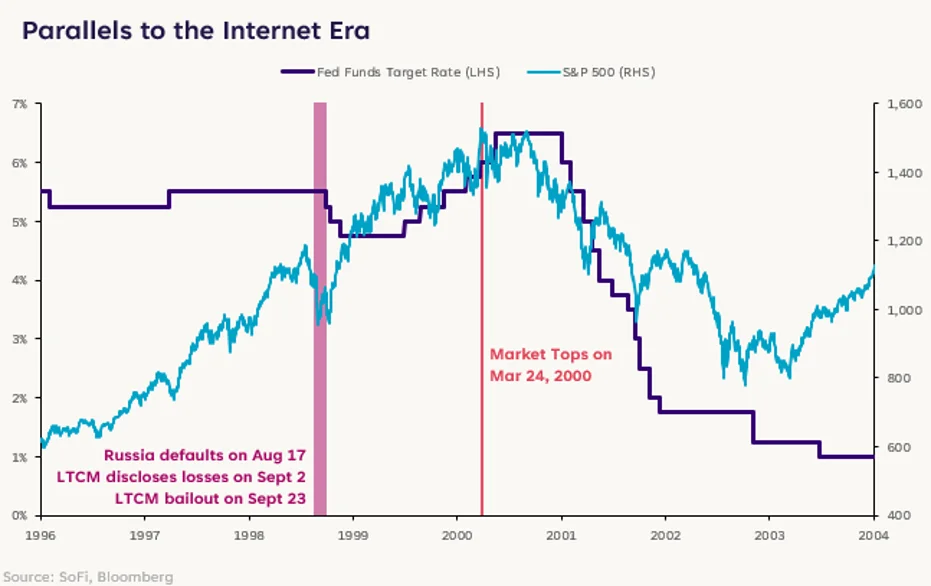
At the risk of oversimplifying the takeaway: The Fed’s hiking cycle in 1999 marked the beginning of the end for the bull market. We fear we would see a similar pattern emerge today.
Not Too Hot to Handle
Of course, it’s not all about the market. We must remember that Fed policy is based on inflation and labor data, and much of the speculation around hikes centers on inflation remaining a pain point in the economy for years.
We agree that inflation is a problem and needs to come down, but we don’t agree that Fed rate hikes are the answer. Inflation is being driven by war-time oil prices and the rising costs of the AI buildout, and the Fed cannot solve either of those problems. What the Fed can do, however, is hurt other parts of the economy that aren’t strong enough to withstand rate hikes.
Despite relatively stable economic data, the Industrials sector has shown recent signs of weakness. We often say the market knows things before the economy does, and this could be one of those times.
After many months of 1% growth, core capital goods orders were flat in August. While one data point does not make a trend, it’s possible that the Industrials sector is sniffing out a deceleration in manufacturing activity.
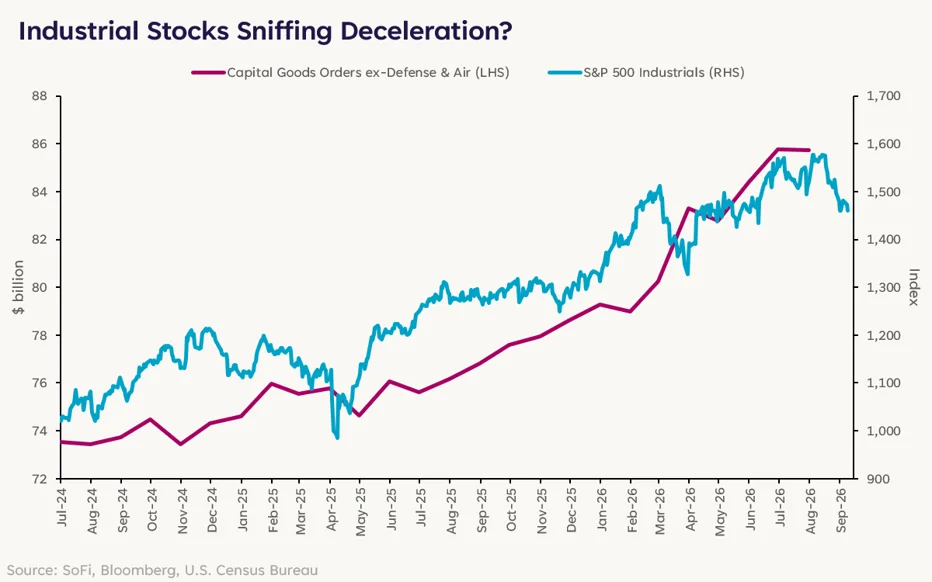
There is a time and a place for rate hikes — namely, when the economy is overheating and we want activity to slow down in order to keep inflation in check. GDP growth of 1.5%-2.5% and job growth averaging under 100k are not indicators of an overheating economy. Not only are rate hikes not the cure, they may actually be the curse we don’t need.
Next week we’ll see whether we were right about any of this. In the meantime, enjoy the ride.
Disclaimer
SoFi Securities (Hong Kong) Limited and its affiliates (SoFi HK) may post or share information and materials from time to time. They should not be regarded as an offer, solicitation, invitation, advice, recommendation to buy, sell or otherwise deal with any investment instrument or product in any jurisdictions. Keep in mind that investing involves risk, and past performance of an asset never guarantees future results or returns. It’s important for investors to consider their specific financial needs, goals, and risk profile before making an investment decision.
SoFi HK does not make any warranties about the completeness, reliability and accuracy of this information and will not be liable for any losses and/or damages in connection with the use of this information.
The information and materials may contain hyperlinks to other websites, we are not responsible for the content of any linked sites. The information and analysis provided through hyperlinks to third party websites, while believed to be accurate, cannot be guaranteed by SoFi HK. These links are provided for informational purposes and should not be viewed as an endorsement. The risk involved in using such hyperlinks shall be borne by the visitor and subject to any Terms of Use applicable to such access and use.
Any product, logos, brands, and other trademarks or images featured are the property of their respective trademark holders. These trademark holders are not affiliated with SoFi HK or its Affiliates. These trademark holders do not sponsor or endorse SoFi HK or any of its articles.
Without prior written approval of SoFi HK, the information/materials shall not be amended, duplicated, photocopied, transmitted, circulated, distributed or published in any manner, or be used for commercial or public purposes.
Crypto and Crypto ETF products are available only to members in eligible jurisdictions who have successfully completed the required assessments and maintain an appropriate risk profile.
This communication is not directed at, and is not intended for distribution to or use by, any person in the United Kingdom. It does not constitute a financial promotion for the purposes of Section 21 of the Financial Services and Markets Act 2000. This material is not available to any UK Person. By accessing, viewing, or relying on this communication, you represent and warrant that you are not a UK Person and that you are not located in the United Kingdom.


About SoFi Hong Kong
SoFi – Invest. Simple.
SoFi Hong Kong is the All-in-One Super App with stock trading, robo advisor and social features. Trade over 15,000 US and Hong Kong stocks in our SoFi App now.