Decoding Markets: Japan Rising
Estimated reading time: 0 minutes
Big in Japan
For decades, global markets have treated Japan like a sleeper car – reliable, but unassuming and in the background. But in recent years, the Japanese economy has started to make some noise — and hit some bumps along the way.
Bank of Japan (BoJ) Governor Kazuo Ueda recently rattled global markets by dropping his strongest hint yet that the central bank will raise its benchmark interest rate on Dec. 19. Traders are now pricing in over 90% odds of a hike.
On the heels of a massive fiscal stimulus plan from the country’s new prime minister, this further suggests Japan is heating up: Inflation seems sticky, wages are rising, and interest rates are moving higher, albeit slowly.
Headlines about Japan might seem like distant noise, but they’re important cautionary signals for U.S. investors nevertheless. Why? A quick recap will help explain.
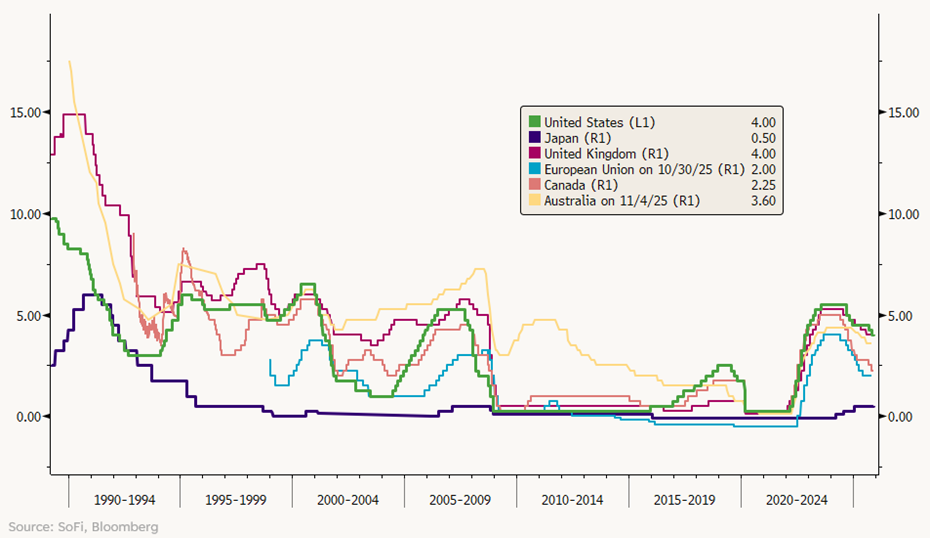
In the wake of the burst of its asset bubble in the early 1990s, Japan was one of the first countries to pursue Zero Interest Rate Policy (ZIRP). That created an opportunity which came to be known as the Yen Carry Trade, one of the most powerful forces in modern finance. Basically, it enabled investors to borrow yen at almost no interest and then invest in higher-yielding assets such as U.S. Treasurys or even tech stocks. The trade became especially attractive as other major central banks raised rates to fight inflation in 2022-2023. Some would say it became the financial equivalent of a free lunch.
Global Benchmark Interest Rates
But as we’ve learned time and time again (most recently during the Japan-driven volatility spike in August 2024) there is no such thing as a never-ending free lunch.
If Japan raises rates, that cheap money will become more expensive. And even though Japanese rates would remain much lower than in other countries, these rate hikes are big relative moves (i.e. going from 0.1 percent to 0.5 percent is a relative increase of 400%). If the yen appreciates quickly in response, investors could be forced to sell assets in order to repay their yen loans. That could inject volatility into markets globally and drag down portfolios, even if U.S. economic growth remains positive.
Sleeping Giant Awakens?
This is relevant because Japan is the largest single foreign holder of U.S. Treasurys, with holdings of nearly $1.2 trillion.
Foreign Holders of U.S. Treasurys
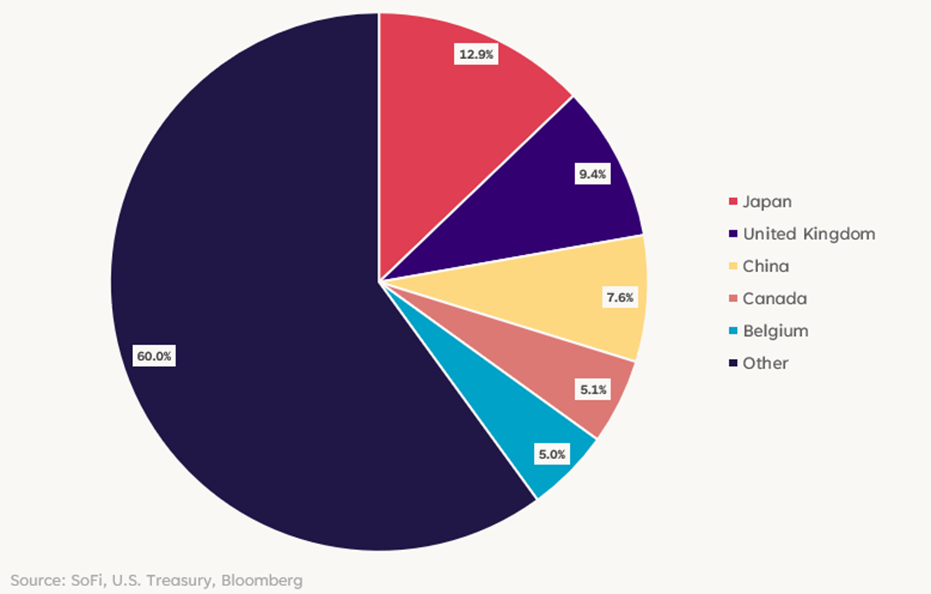
While Japan only accounts for 13% of foreign Treasury ownership (and less than 5% when taking into account U.S. ownership), this is still a mountain of cash that has reliably been invested in Treasurys for years. And if Japanese investors can increasingly earn a decent, safe return on government bonds at home without worrying about currency exchange risk, they have less incentive to buy U.S. debt.
If they were to start selling Treasurys to bring that money back to Japan, that would increase the supply of Treasurys on the market, which would likely push prices lower and yields higher (absent intervention from say, the Federal Reserve). Higher yields have broad impacts on the U.S. economy, making mortgages more expensive for consumers and often weighing on stock valuations.
Lost in Translation
So, does this mean U.S. investors should start reading the minutes of the Bank of Japan’s policy meetings? No, but it’s important to understand that U.S. markets are not insulated from Japanese monetary policy.
A hawkish Fed meeting, weak jobs report, and rapid yen strengthening in late July/early August 2024 led to a rapid unwind of the carry trade and a sharp, albeit temporary, crash in global stocks.
What does that mean for your portfolio? Here’s some guidance:
- Expect volatility: As the BoJ continues to normalize rates, there could be more pockets of volatility in Japanese markets, and that has the potential to spillover into U.S. markets.
- Watch the dollar: Narrowing interest rate differentials between Japan and other major economies, including the U.S., should boost the yen, and in turn could weaken the dollar.
- Consider a move: Japanese stocks with lower export sensitivity (such as small-caps) could give some protection if the yen were to meaningfully appreciate.
Japan’s potential return to monetary normalcy is a healthy sign for the global economy in the long run. But in the short term, it changes the flow of the global river of money. It’s important to know where you’re swimming if, and when, the tide turns.
Disclaimer
SoFi Securities (Hong Kong) Limited and its affiliates (SoFi HK) may post or share information and materials from time to time. They should not be regarded as an offer, solicitation, invitation, advice, recommendation to buy, sell or otherwise deal with any investment instrument or product in any jurisdictions. Keep in mind that investing involves risk, and past performance of an asset never guarantees future results or returns. It’s important for investors to consider their specific financial needs, goals, and risk profile before making an investment decision.
SoFi HK does not make any warranties about the completeness, reliability and accuracy of this information and will not be liable for any losses and/or damages in connection with the use of this information.
The information and materials may contain hyperlinks to other websites, we are not responsible for the content of any linked sites. The information and analysis provided through hyperlinks to third party websites, while believed to be accurate, cannot be guaranteed by SoFi HK. These links are provided for informational purposes and should not be viewed as an endorsement. The risk involved in using such hyperlinks shall be borne by the visitor and subject to any Terms of Use applicable to such access and use.
Any product, logos, brands, and other trademarks or images featured are the property of their respective trademark holders. These trademark holders are not affiliated with SoFi HK or its Affiliates. These trademark holders do not sponsor or endorse SoFi HK or any of its articles.
Without prior written approval of SoFi HK, the information/materials shall not be amended, duplicated, photocopied, transmitted, circulated, distributed or published in any manner, or be used for commercial or public purposes.


About SoFi Hong Kong
SoFi – Invest. Simple.
SoFi Hong Kong is the All-in-One Super App with stock trading, robo advisor and social features. Trade over 15,000 US and Hong Kong stocks in our SoFi App now.